
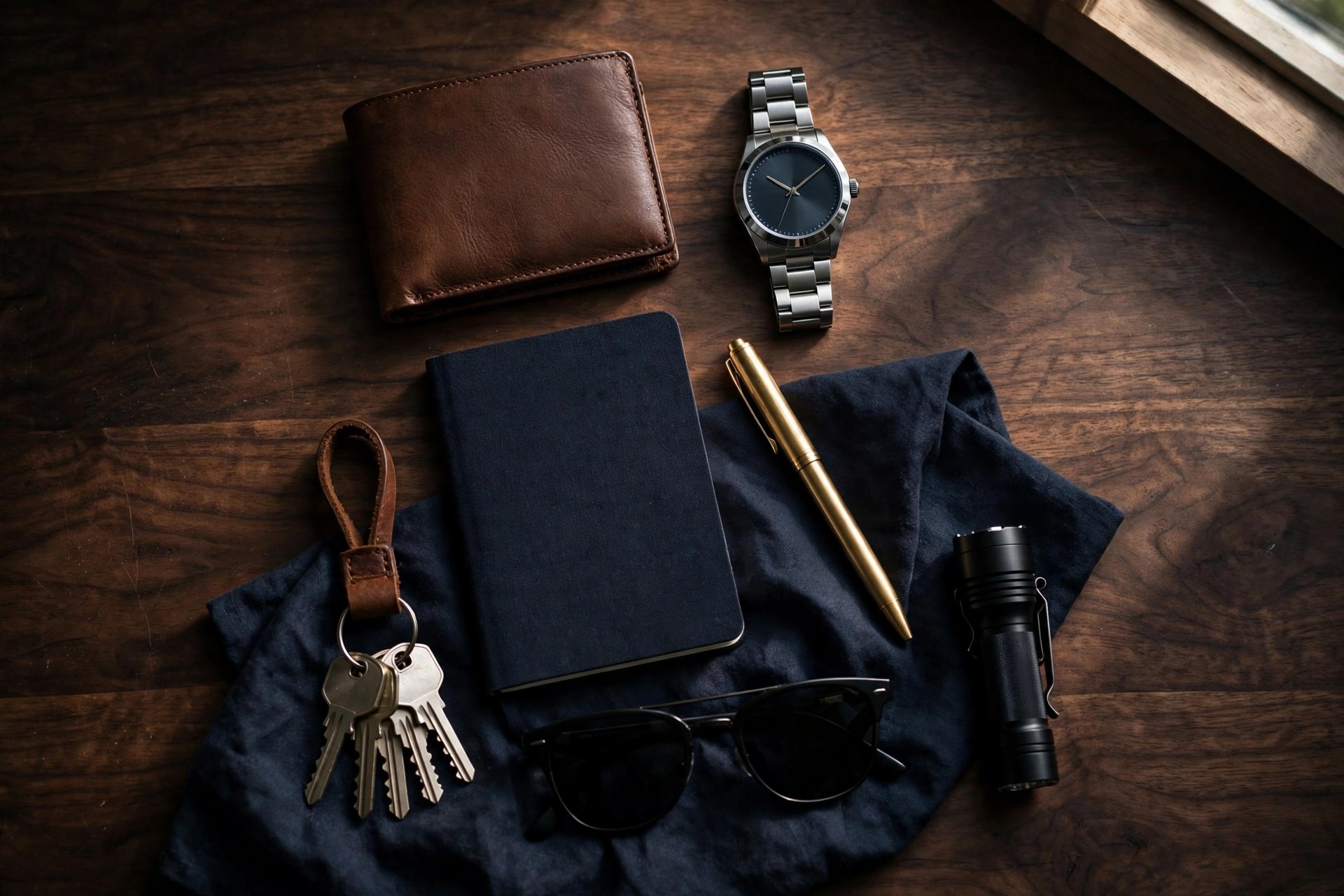
Everyday carry is not about owning more gear. It is about the small kit you actually have on you when the moment calls — a pen when a signature matters, light when the power drops, a notebook when an idea would otherwise vanish. Build it once, build it well, and it quietly makes you the most prepared man in the room.
Most men's pockets tell the opposite story: a wallet swollen with receipts from two years ago, three loyalty cards for places they no longer visit, keys to locks they cannot name, and nothing useful when something real comes up. Everyday carry — EDC, to the men who have turned it into a discipline — is the correction. It is a system, not a shopping list: a short set of tools chosen on purpose, carried the same way every day, and audited often enough that everything in it still earns its place.
This guide is the system. No product hype, no tactical cosplay, and nothing here that a man in a suit cannot carry into a boardroom. Three tiers, five rules, and a weekend build that ends with pockets that work as well as the rest of the outfit.
The core kit at a glance
| Tier | Where it lives | What belongs there |
|---|---|---|
| Tier 1 — On your person | Pockets, wrist, belt | Wallet, keys, watch, pen, phone, one small tool, light |
| Tier 2 — In your bag | Briefcase, backpack, weekender | Charger and cable, notebook, grooming basics, mints, stain pen, spare cash |
| Tier 3 — At base | Car, desk, entryway tray | Fuller tool kit, first-aid basics, umbrella, spare charger, the landing strip that resets Tiers 1 and 2 nightly |
Read the table as a pyramid. Tier 1 is tiny and never changes. Tier 2 flexes with the day. Tier 3 holds everything else, so Tiers 1 and 2 never have to. Most carry problems are really pyramid problems: a man trying to live at Tier 3 out of two front pockets.
The rules: how an item earns its place
- It must have a job. Name the job in one sentence — "opens packages and cuts cord," "writes when phones are rude or dead." If you cannot name the job, it is decoration, and decoration belongs on a shelf.
- It must be used weekly. Daily is ideal, weekly is the floor. The exception is the short emergency list — light, a way to make fire is not on it for most men, a small first-aid answer in the bag — and even those get re-justified at every audit.
- One item, one job — mostly. Duplication is weight without capability. Two pens is a habit; four pens is a symptom. The honest exception is light and writing: both are cheap, both fail at the worst moment, and a backup of each weighs almost nothing.
- Quality where it touches you daily. The wallet, the watch, and the pen are handled dozens of times a day. Buy those once and well — full-grain leather that ages instead of peeling, metal that feels like metal. Save the experimenting for Tier 3, where a failure costs an errand, not a day.
- It must disappear until needed. Good carry rides flat, silent, and forgotten. If you can hear your keys from across the room or feel your wallet when you sit, the kit is wearing you.
Hold every candidate up to those five and most buying decisions make themselves. Our guide to suit accessories for men runs on the same principle: a few considered pieces, each with a job, beat a drawer of novelties every time.
Tier 1 — what lives on your person
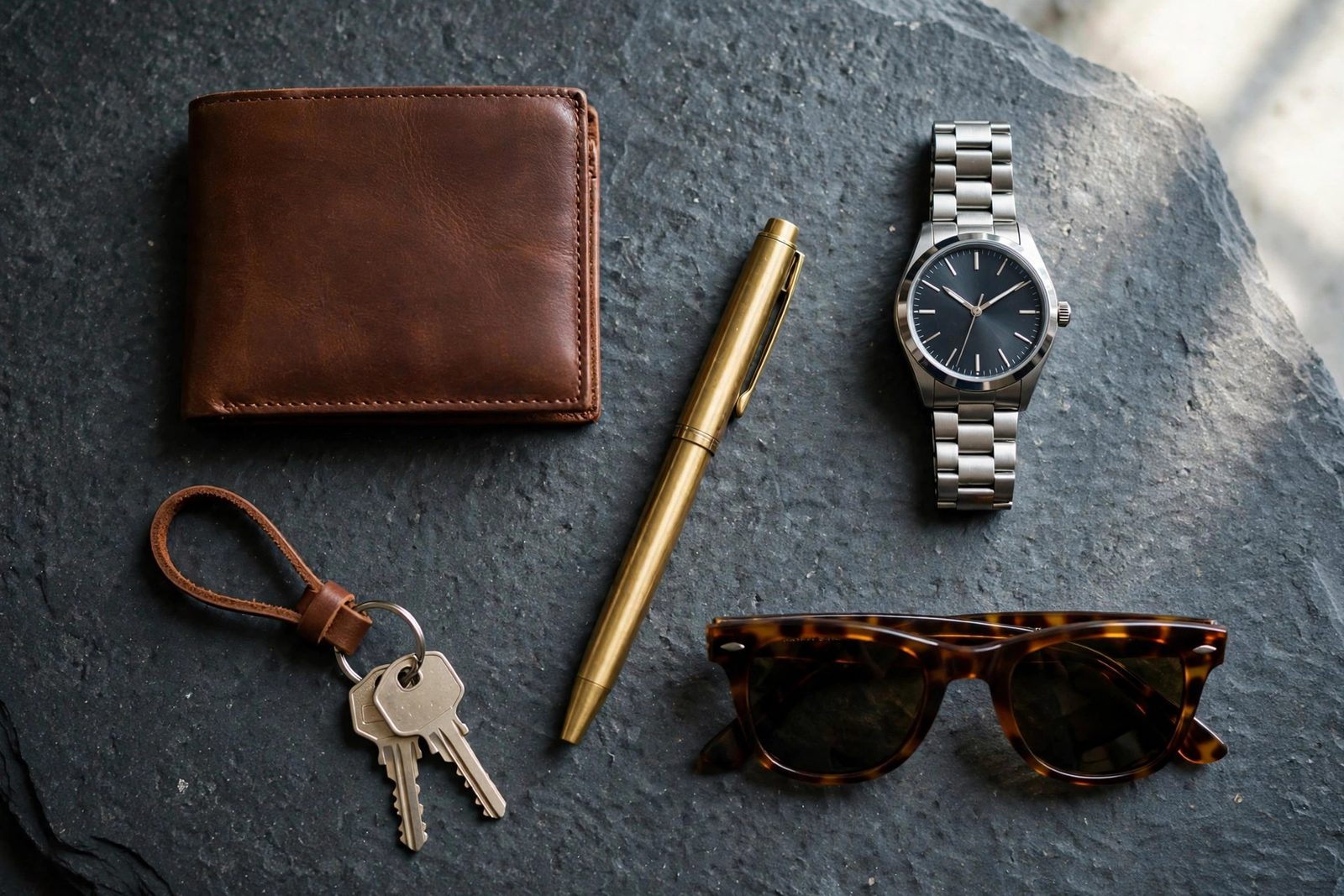
The wallet. Six cards is the working ceiling for most men: payment card, backup payment card, ID, one insurance card, and two slots of honest flex. Cash folded flat — a small reserve makes you useful when a card reader dies or a valet stand is cash-only. If your wallet needs its own chair when you sit down, it is not a wallet anymore; it is an archive. Archives live at Tier 3.
The keys. Every key on the ring should open something you can name. That sounds obvious until a man actually does the audit and finds four mysteries. Keep the ring to house, car, and office, on a loop or clip that keeps them high and quiet in the pocket rather than swinging against a phone screen.
The watch. The one piece of carry that is also presentation. A watch earns Tier 1 twice over: it tells time without a phone's hundred distractions, and it finishes an outfit the way a signature finishes a letter. Choosing one is its own decision — our guide to the best everyday watches under $500 walks the shortlist — but the carry rule is simple: one watch you trust, worn daily, beats a rotation you have to think about.
The pen. A pen of your own ends the small humiliation of borrowing one to sign something that matters. Metal, refillable, and heavy enough to feel deliberate. It lives in the same pocket every day, because a pen you have to hunt for is a pen you effectively do not carry.
One small tool, and a light. For most men this is a compact multi-tool or a simple folding knife for packages, cord, and the hundred small mechanical negotiations of a week — carried where your workplace and local rules allow, and left at base when they do not. Pair it with a pocket light smaller than your thumb: phone flashlights are fine until the phone is the thing that died. These two are the most-used, least-regretted additions men report when they build a kit — and the two most often bought oversized. Small is the entire point.
Tier 2 — what lives in your bag
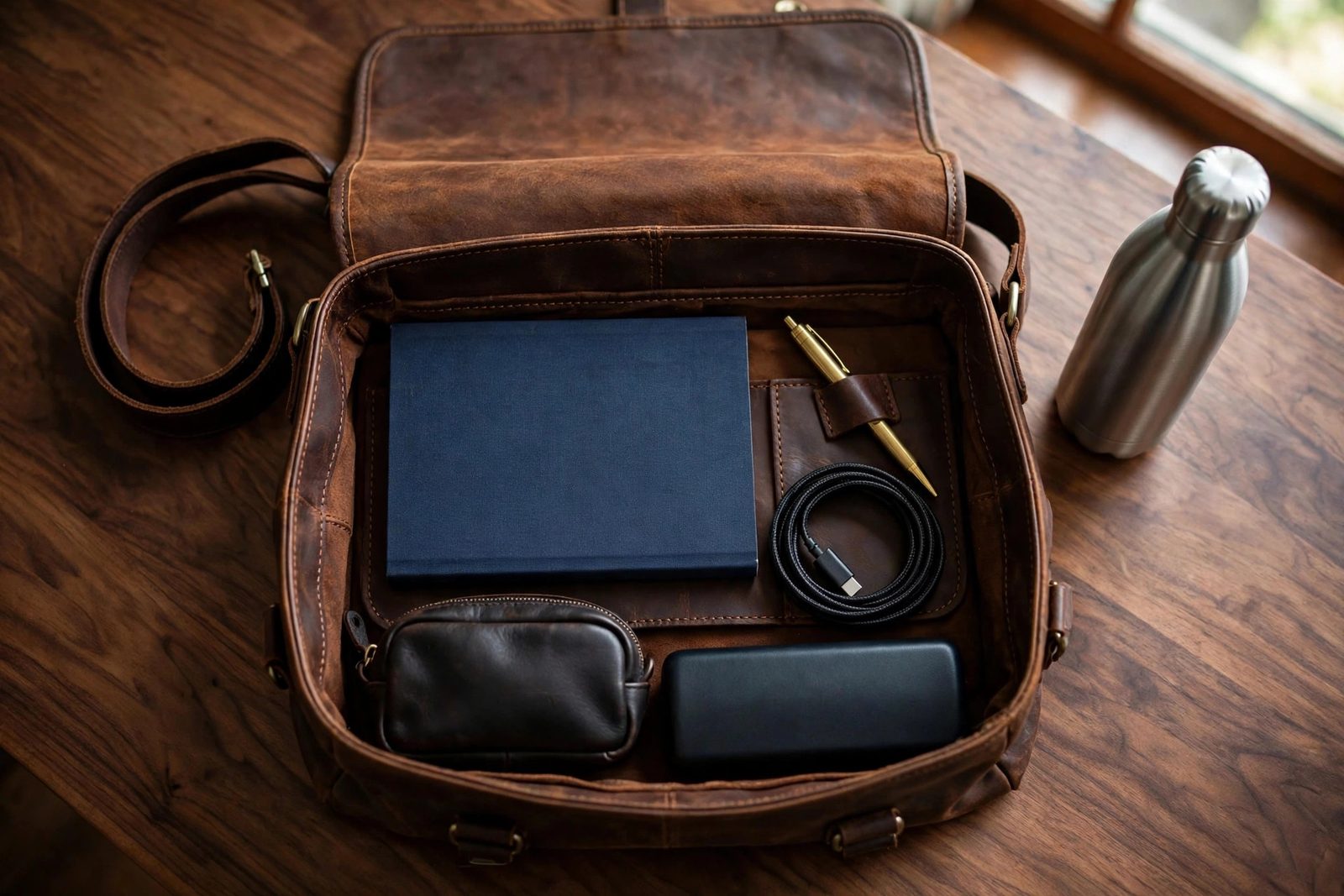
The bag is where carry gets honest about modern life. A charger and a cable that actually fits your phone. A notebook with real paper, because ideas, names, and numbers dictated across a noisy room do not belong in an app you will never open again. Grooming insurance: mints, a stain pen, a small comb, lip balm in winter — the unglamorous four that have saved more presentations than any gadget. Spare cash in a separate pocket, kept separate precisely so it survives a lost wallet. And one comfort item chosen personally — earbuds, a book, sunglasses in a hard case — because a bag that is all utility and no pleasure gets left at home, and a kit left at home is not a kit.
The bag rule that keeps Tier 2 from becoming a junk drawer with a handle: it gets emptied onto the desk every Sunday night, and everything goes back in on purpose or not at all. Receipts, dead batteries, and the conference lanyard from March fail the five rules the same way pocket clutter does.
Tier 3 — what lives in the car and at your desk
Tier 3 is the supply depot, and its most important item is not a tool — it is the landing strip: a tray or small box by the door where Tiers 1 and 2 are emptied every night and rebuilt every morning. Thirty seconds, same place, same order. This single habit is the difference between a system and a pile; keys are never lost in a home that has a landing strip, and wallets never spend the night in yesterday's trousers.
Around it, the car and desk hold the fuller versions: a real tool kit instead of a pocket one, first-aid basics, an umbrella that lives in the car so the good one in the bag stays dry-side insurance, spare chargers, a change of shirt at the office if your days run long. Tier 3 absorbs every "just in case" that would otherwise colonize your pockets. When an item's job is real but rare, Tier 3 is its home — close enough to matter, far enough to keep the daily kit lean.
Three builds: office, travel, weekend
| Build | Add | Leave behind |
|---|---|---|
| Office | The good pen, notebook, stain pen, mints | Anything bulky or loud; the kit must ride flat under a jacket |
| Travel | Charger plus backup cable, earbuds, sunglasses, a pen that writes on any form at any altitude of fatigue | Any tool that will not clear security — move it to checked luggage or Tier 3 |
| Weekend | Sunglasses, the light, cash for markets and tips | The notebook and the office pen — the weekend kit should feel like a day off |
Notice what never changes across the three builds: wallet, keys, watch. The core is the core. Everything else is a module you clip on for the day in front of you — the same logic as taking one suit from day to night in our day-to-night style hacks: change the few things that change the register, keep the foundation.
The mistakes that turn carry into clutter
- Buying the kit before living the problem. Carry the basics for two weeks and write down every moment you wished for something you did not have. That list — your list — is the only shopping list that matters.
- Mistaking big for capable. The oversized multi-tool and the flashlight built like a club get left in drawers. Capability you do not carry is trivia.
- Matching sets bought for looks. A kit assembled to photograph well usually carries badly: duplicated jobs, fragile finishes, nothing repaired and everything replaced. Working kits look earned, because they are.
- Never auditing. Jobs change, locks change, lives change. A kit that is not re-justified twice a year slowly becomes a museum of a previous life.
- Carrying for the fantasy day instead of the real one. Build for your actual Tuesday — the commute, the desk, the school run, the dinner — and keep the expedition gear at Tier 3, where fantasy is allowed to live rent-free.
Build yours this weekend: the seven-day audit
You do not need to buy anything to start. You need one honest week:
- Day 1 — The dump. Everything out of every pocket and bag, onto the landing strip. Photograph it. Most men are carrying two of something and none of the thing they needed yesterday.
- Days 2–6 — The tally. Carry only wallet, keys, watch, phone. Keep a note — paper, in the notebook you are about to justify — of every moment you reached for something else. Each reach is a vote.
- Day 7 — The rebuild. Anything with three or more votes earns Tier 1 or 2. Anything with none stays at Tier 3 for a month; if the month passes quietly, it leaves the system entirely. Set the landing strip, load the kit, and put a calendar note six months out to do it again.
That is the whole build. A weekend of attention, a week of evidence, and a kit that reflects your life instead of a catalogue.
Questions, answered
How much should an everyday carry kit cost? Less than the internet wants you to spend. The system costs almost nothing — the audit, the tiers, and the landing strip are free. Spend only where the rules point: the wallet, watch, and pen you touch daily, bought once and well. Everything else can start ordinary and be upgraded only after it has earned votes in your tally.
Is a knife or multi-tool appropriate for the office? It depends on your workplace's policies and the rules where you live, and both outrank any guide — check them first, and when in doubt, the tool lives at Tier 3. Most office jobs a small tool does — packages, cord, a loose thread — are just as well handled by small scissors kept in the desk.
What about my phone — is it not the whole kit already? The phone is the kit's weakest link disguised as its strongest: it is light, wallet, notebook, and torch until the battery dies, it is lost, or the moment calls for discretion a glowing screen cannot offer. Carry assumes the phone fails sometimes, and stays useful anyway.
How do I keep a kit from ruining the line of a suit? Slim everything, distribute it — wallet and phone in separate pockets, keys high on a clip, pen in the jacket — and let the bag do the heavy work. A tailored silhouette and a working kit are entirely compatible; it is the un-audited pocket, not the prepared one, that bulges.
Read next
Carry is one expression of the Pinstripe idea — own fewer, better things, and know why each one is there. The watch decision lives in our guide to the 6 best everyday watches under $500. The outfit those pockets sit in is covered by the complete guide to the pinstripe, the pattern this magazine is named for. And when the day runs long, the best wellness tech gifts for men covers the recovery side of the same philosophy: gear that earns its place by being used every day.