
Updated November 2026.
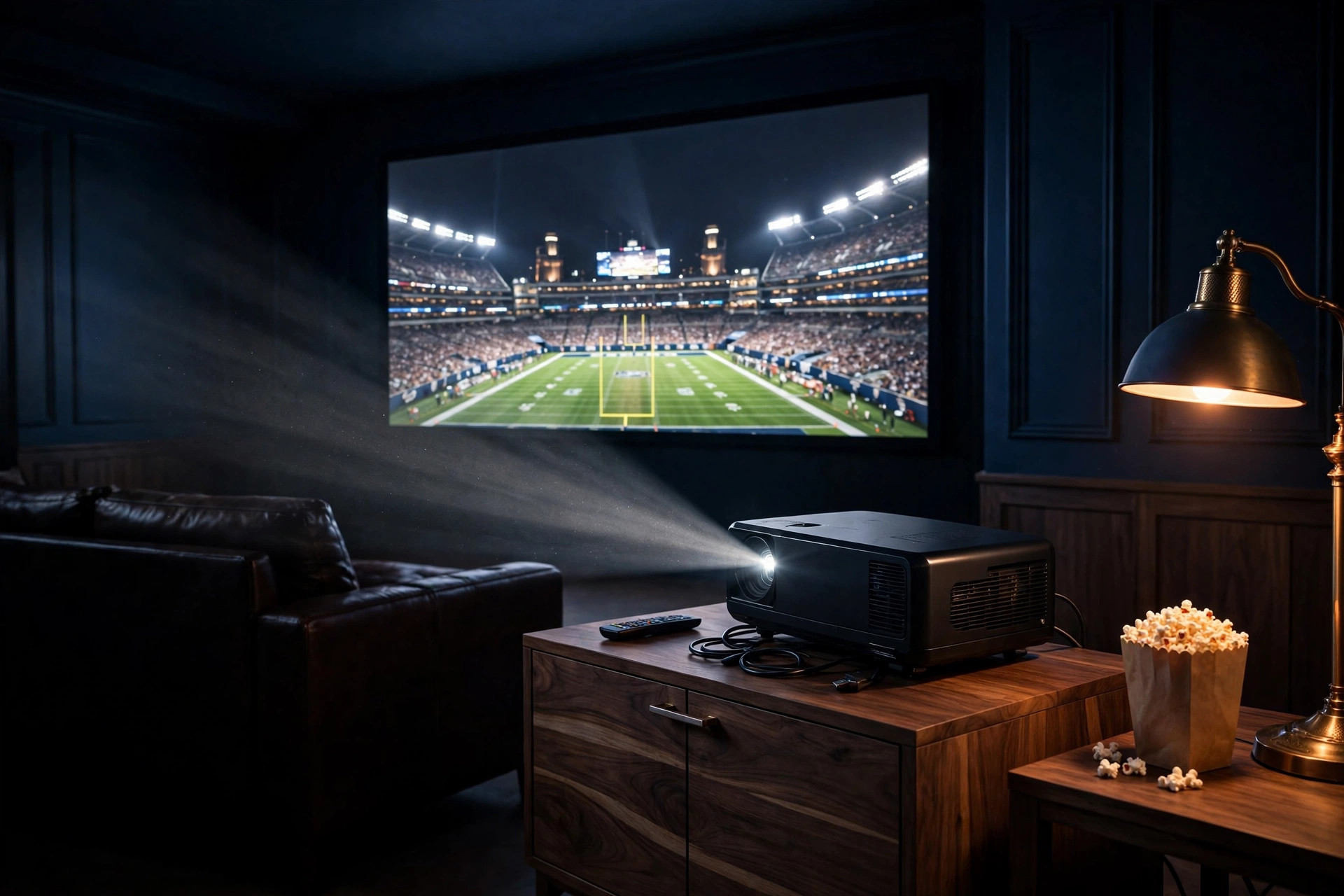
The best projectors for movies, gaming and sports are no longer a hobbyist's compromise. The current generation — laser light engines, true 4K images, Dolby Vision, console-ready input lag — puts a 120-inch picture in a normal living room for less than a mid-range big-screen TV, and a genuine theater picture in a dark room for less than the TV it replaces. The trick is buying for the room you actually have: how much light it gets, how far the projector can sit from the wall, and whether the big screen is mostly for films, for game day, or for the console underneath it.
This guide is the short list: six projectors that cover every honest use case and every rung of the ladder, from a $1,099.99 all-in-one that sets itself up to a $2,599 flagship bright enough to fight a lit room. Every price below was verified at publish on the seller's own page, every pick is in stock and buyable there, and the lineup is all new — the previous version of this guide recommended a shelf of discontinued portables, and it has been retired in full.
Disclosure: Pinstripe may earn a portion of sales from products purchased through links on this page. No brand paid for a place on this list, and nothing here was included because of a commission.
Best Projectors for Movies, Gaming and Sports — The Quick List
| Pick | Product | Best for | Price |
|---|---|---|---|
| 1 | Nebula Cosmos 4K SE | Best for most living rooms | $1,099.99 |
| 2 | XGIMI Horizon 20 | Best all-in-one upgrade | $1,559 |
| 3 | BenQ TK710STi | Best for gaming | $1,899 |
| 4 | Valerion VisionMaster Pro 2 | Best for a dark theater room | $2,099 |
| 5 | Hisense PX3-PRO | Best ultra-short throw | $2,497.97 |
| 6 | XGIMI Horizon 20 Max | Best for bright rooms — the flagship | $2,599 |
Short on time? Buy the Nebula if the projector will live on a sideboard and move around the house. Buy the Valerion if it is going into a dark room and staying there. Buy the Hisense if there is no room for a projector anywhere except directly under the screen. Everything below explains why.
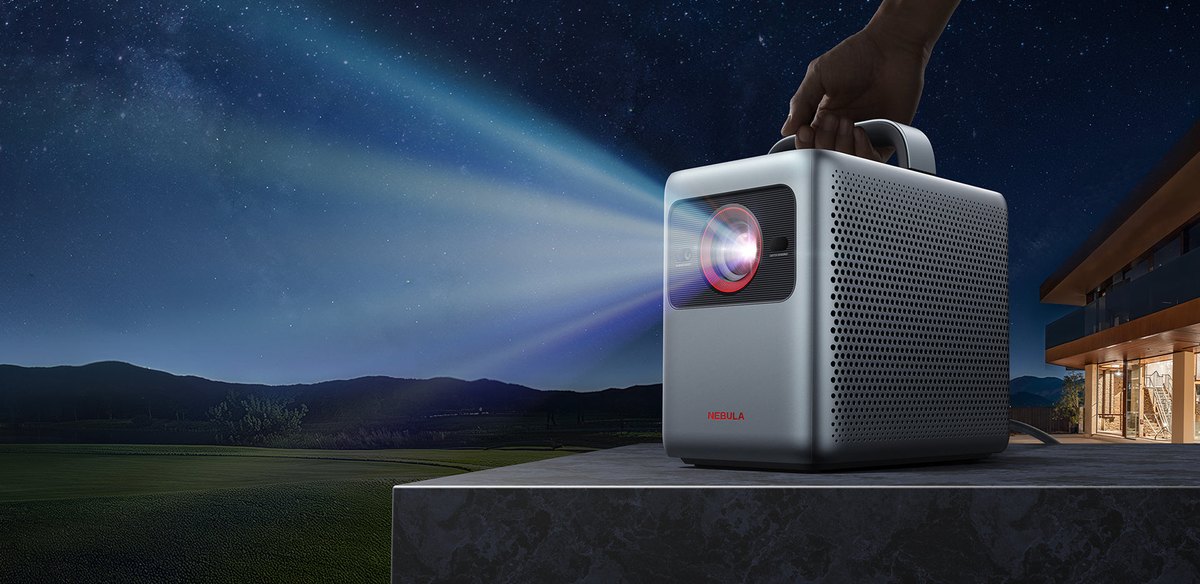
1. Nebula Cosmos 4K SE — Best for Most Living Rooms
Anker's Nebula line is what happened when portable projectors grew up. The Cosmos 4K SE pairs a hybrid LED-and-laser light engine with 1,800 ANSI lumens, Dolby Vision and Google TV with official Netflix in 4K — no dongle, no sideloading, no workarounds. Its automatic setup (Nebula calls it IEA 4.0) focuses, squares and aligns the picture when you set it down, and the soft carry handle is not a gimmick: this is the projector that moves from the living room to the bedroom to the backyard wall without a planning meeting.
Sound is built in and credible — dual 15-watt speakers with Dolby Audio — and an HDMI 2.1 port with eARC is there when you graduate to a soundbar or receiver. Input lag under 19 milliseconds in its Extreme Game mode keeps it honest for casual console play. Two honest limits: it needs mains power (there is no battery), and 1,800 lumens wants the lights low for films. At $1,099.99 on Amazon — $200 under its $1,299.99 list at publish — it is the default recommendation for most men, and the cheapest way into real 4K projection that does not feel like a toy.
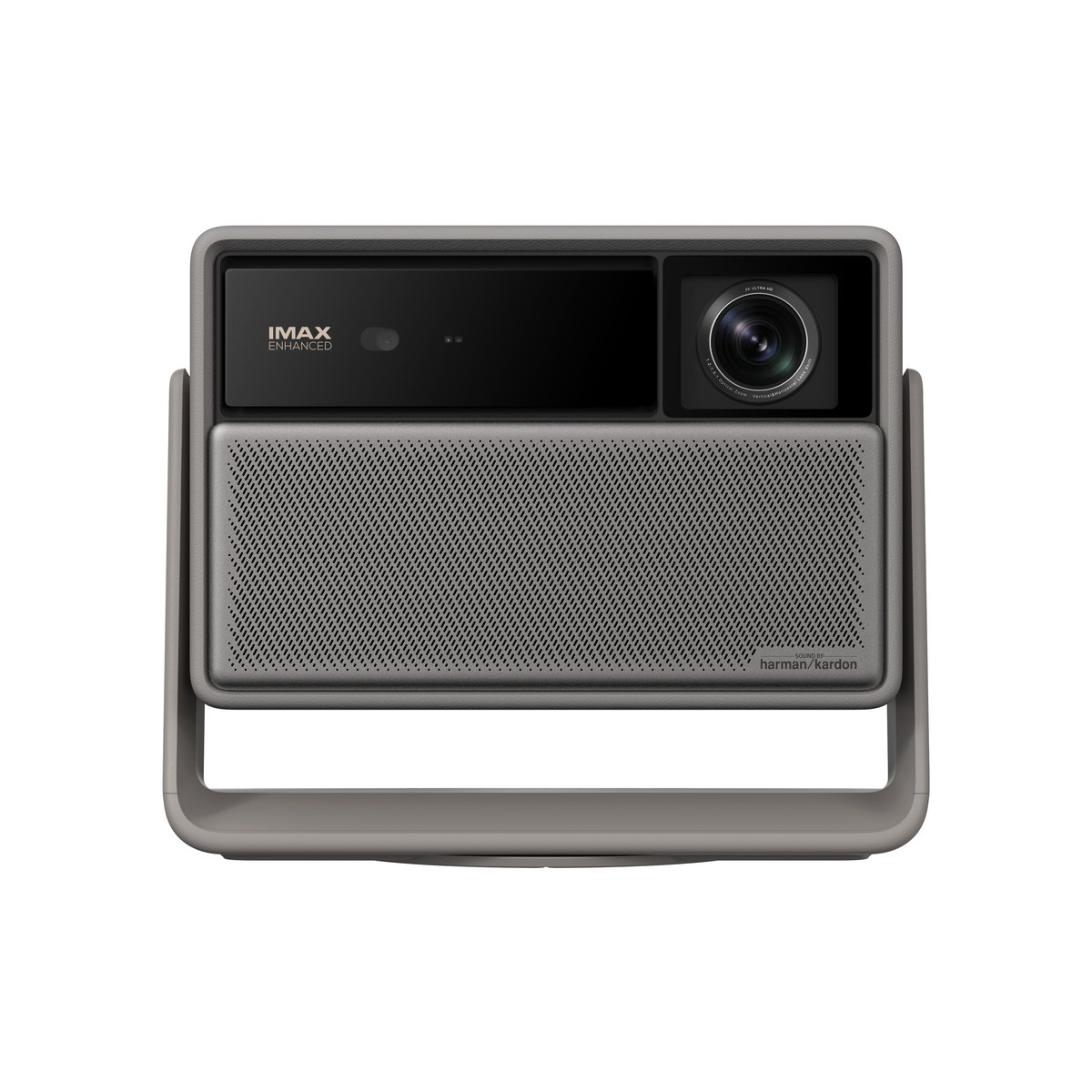
2. XGIMI Horizon 20 — Best All-in-One Upgrade
The Horizon 20 is the step up for the man who knows the projector is staying. XGIMI's X-Master RGB triple-laser engine delivers 3,200 ISO lumens and a 20,000:1 contrast ratio across 110% of the BT.2020 color space, and the certification stack is the full one: IMAX Enhanced, Dolby Vision, HDR10+ and Filmmaker Mode. Where the Nebula automates setup with software, the Horizon 20 adds real optics — lens shift that moves the image without degrading it — plus Harman Kardon speakers and Google TV in a fabric-finished body with an integrated stand that looks deliberate on a console.
It is $1,559 direct from XGIMI at publish, down from a $1,699 list, in stock with free shipping. The honest comparison inside this guide: against its own flagship sibling at pick six, the Horizon 20 gives up brightness and some optical range; against everything under it, it is simply the more complete machine. If the room is dim-to-dark and the budget has a ceiling, this is where the ladder's value peaks.
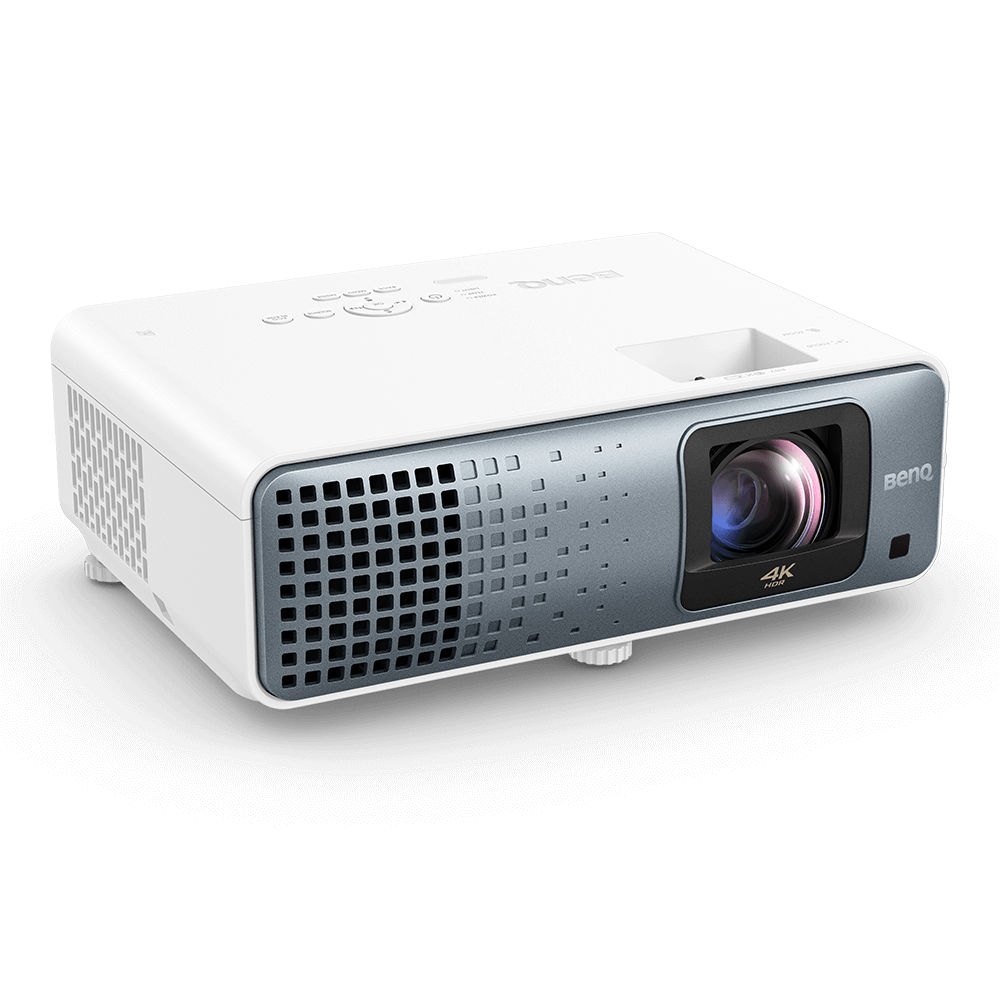
3. BenQ TK710STi — Best Projector for Gaming
BenQ builds projectors the way it builds gaming monitors: around the numbers players actually feel. The TK710STi is a short-throw laser projector — a 100-inch image from roughly five and a half feet — with 3,200 ANSI lumens, true 4K, and input lag of 4.16 milliseconds at 1080p/240Hz and 16.7 milliseconds at 4K/60Hz. That second figure is the one that matters for a PS5 or Xbox Series X, and it is fast enough that the projector disappears from the equation. Dedicated HDR game modes, eARC for a proper sound system, and BenQ's QS02 Android TV dongle in the box round it out.
Short throw is the quiet advantage here: in a spare room, a den, or a rental where ceiling mounting is not happening, five feet of clearance is a setup that exists, and a traditional projector's twelve feet is one that does not. The trade is placement discipline — a short-throw image magnifies every bump in the wall, so pair it with a fixed screen if you can. $1,899 on Amazon at publish, against a $1,999 list.
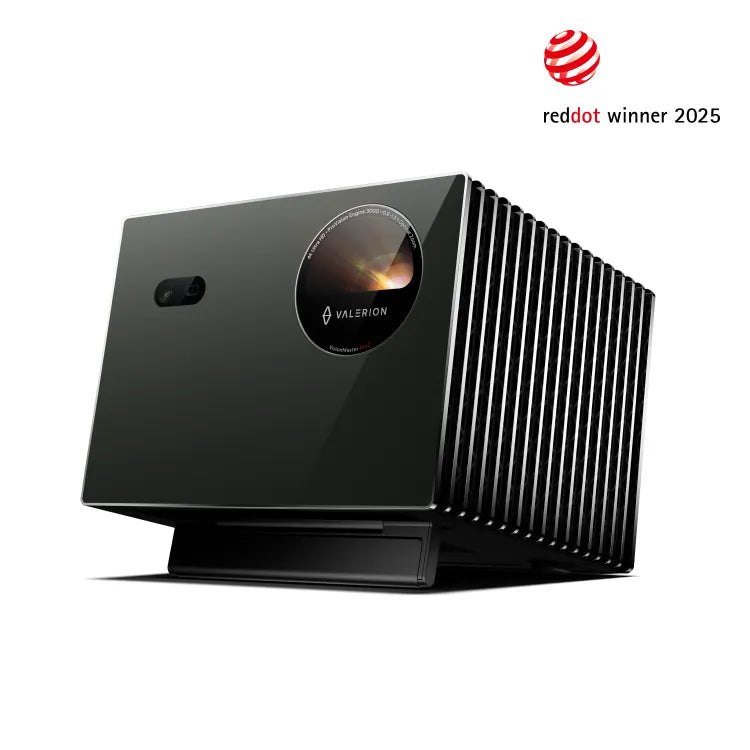
4. Valerion VisionMaster Pro 2 — Best for a Dark Theater Room
Every projector on this list can make a big picture. The VisionMaster Pro 2 is the one built to make a dark picture — properly dark, which is where films live. Its Enhanced Black Level system dims the RGB triple-laser light source frame by frame to reach a 15,000:1 contrast ratio, so letterbox bars and night scenes read as black rather than the glowing grey that gives projection a bad name. Add 3,000 ISO lumens, 110% Rec.2020 color, Dolby Vision, HDR10+, IMAX Enhanced and Filmmaker Mode, and it is the connoisseur's pick of the six — the one reviewers keep comparing to machines at twice the price.
It games seriously too (4ms at 1080p/240Hz, HDMI 2.1, Google TV, 4GB of memory and 128GB of storage), and its 0.9–1.5:1 optical zoom helps placement — though there is no lens shift, so the shelf or mount position has to be right. At $2,099 on Amazon at publish — $900 under its $2,999 list — it is also the guide's best current deal at the serious end. In a light-controlled room, buy this one.
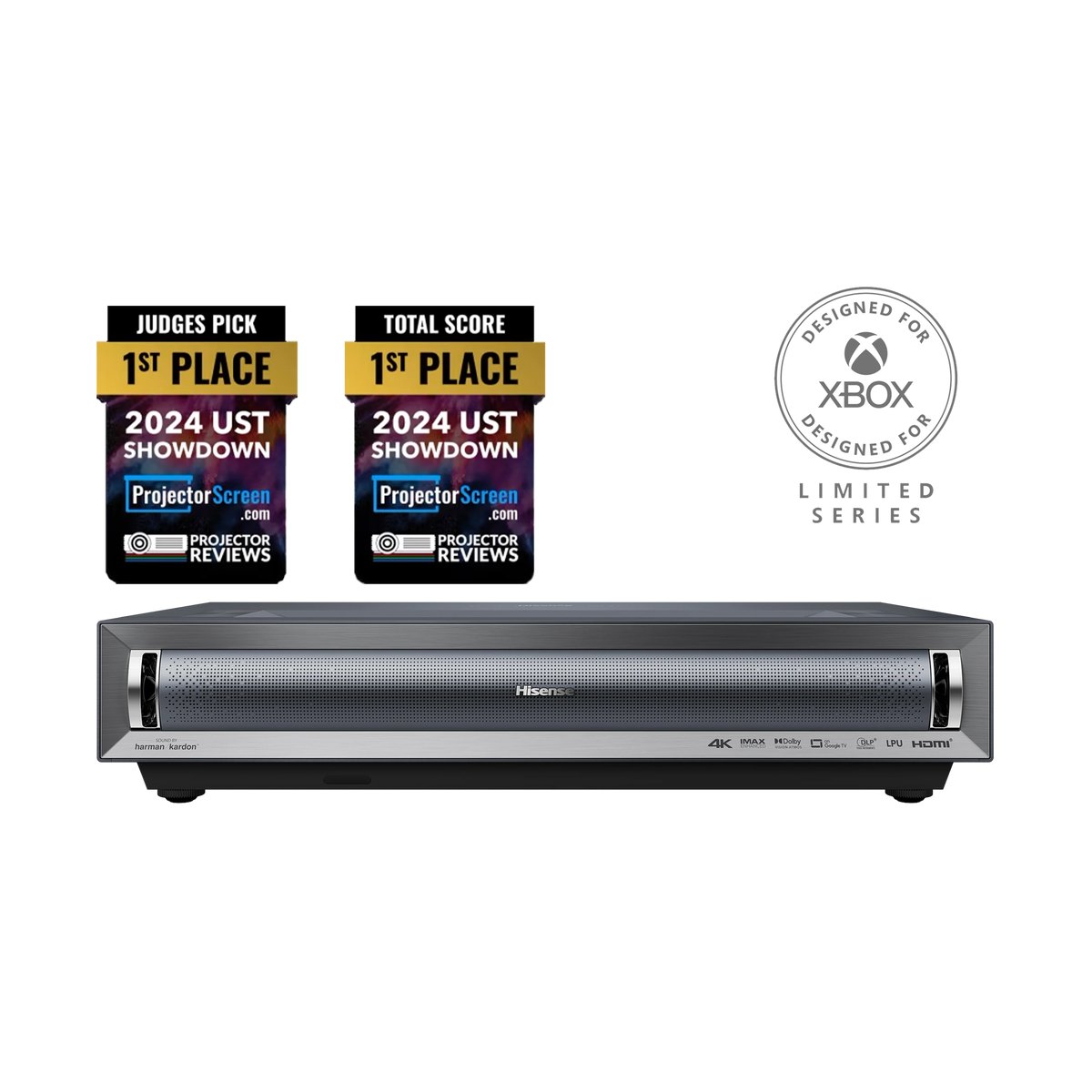
5. Hisense PX3-PRO — Best Ultra-Short Throw Projector
Ultra-short throw changes the whole negotiation with a room. The PX3-PRO sits on the credenza, inches from the wall, and throws an 80- to 150-inch 4K image upward — no mount, no long cable runs, nobody's shadow crossing the screen when they get up for a drink. Inside is a triple-laser engine with 3,000 ANSI lumens and 110% BT.2020 color, Dolby Vision and IMAX Enhanced certification, Google TV, and a 50-watt front-firing Harman Kardon speaker system that is genuinely the best audio in this guide — for many rooms, the soundbar becomes optional.
Hisense bills it as the first ultra-short throw designed for Xbox, with a 240Hz high-refresh mode for gaming alongside its film credentials, and the laser is rated for 25,000-plus hours. Two costs to plan for: it wants a dedicated UST screen to perform at its best in a lit room (budget for one), and the fixed geometry means the console depth and height have to fit the screen size you choose. $2,497.97 on Amazon at publish, well under its $3,499.99 original list.
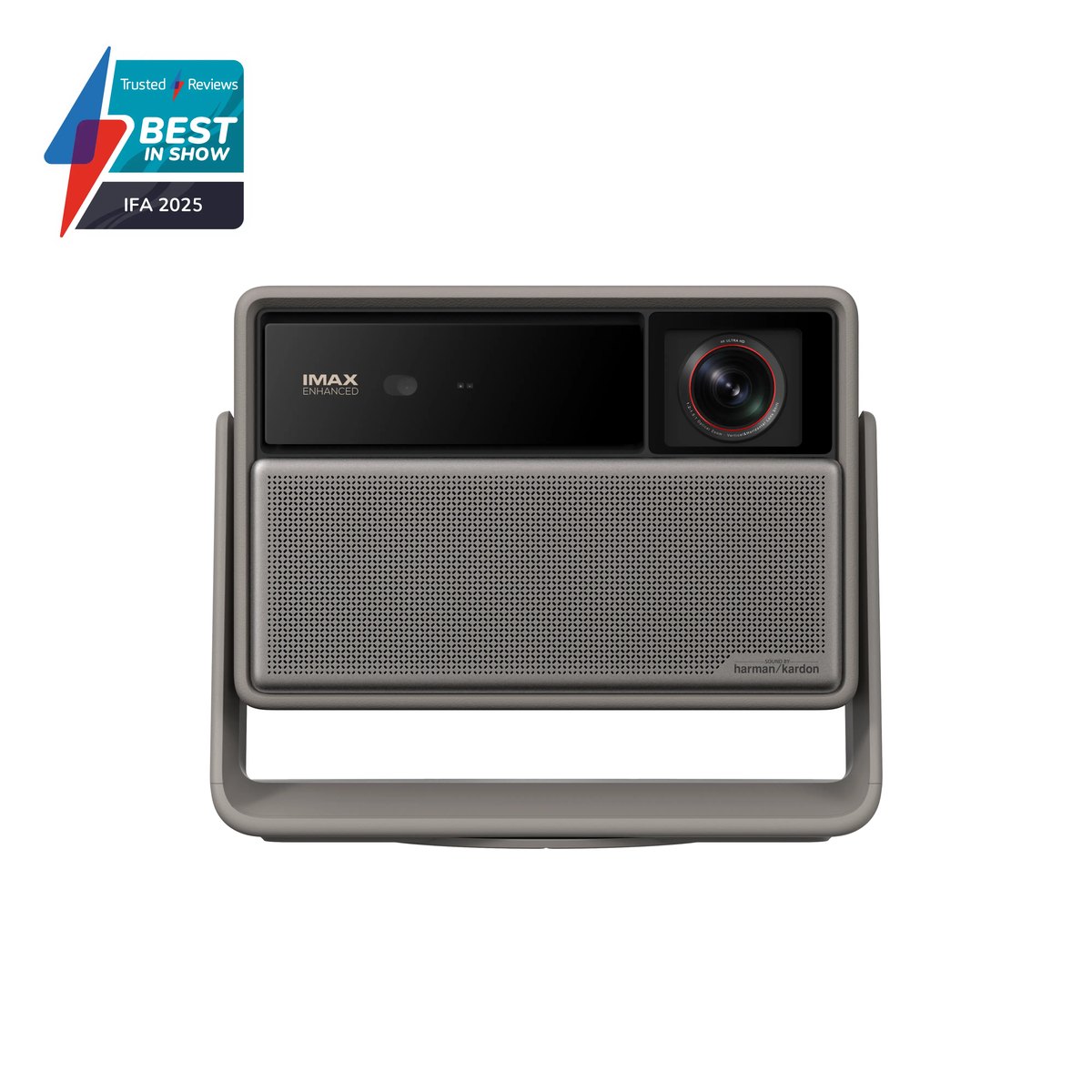
6. XGIMI Horizon 20 Max — Best for Bright Rooms, the Flagship Pick
Brightness is the tax every projector pays to a living room, and the Horizon 20 Max is the pick that can afford it: 5,700 ISO lumens from its X-Master RGB triple-laser engine, the brightest figure in this guide by a wide margin, with 20,000:1 contrast and 110% BT.2020 color behind it. Sports on a Sunday afternoon, a film with the blinds half open, a screen at the large end of its range — this is the machine that does not ask the room to go dark first. It keeps the flagship paperwork too: Dolby Vision, HDR10+, IMAX Enhanced and Filmmaker Mode.
The Max also gets the serious optics — optical zoom and lens shift that place the image without digital cropping — and game modes that run to 1-millisecond-class response at 1080p/240Hz under XGIMI's specified conditions. At $2,599 direct from XGIMI at publish, down from $2,999, it is $500 more than the Valerion and earns it exactly one way: light. Dark room, the Pro 2 is the connoisseur's buy; a room that stays lived-in, this is the flagship. The pair of them frame the whole guide — choose by your room, not by the spec sheet. For the rest of a room built to this standard, our everyday carry guide covers the kit that travels, and the best everyday watches under $500 covers the wrist.
How to Choose a Projector for Movies, Gaming and Sports
Start with throw distance, not specs. Measure where the projector can sit and where the screen will be, then let that distance pick the category: ultra-short throw (the Hisense) for inches from the wall, short throw (the BenQ) for a coffee-table distance, standard throw (the rest) for a shelf or mount across the room. A brilliant projector placed wrong is a bad projector; the category decision is the one you cannot fix later in a menu.
Read brightness in the standard given, and match it to your light. Manufacturers quote ANSI lumens or ISO lumens — close cousins, not interchangeable numbers, so compare within a standard. As a working rule: a dedicated dark room is happy from about 1,800 lumens upward; a living room with controlled light wants 3,000 or more; a bright room at midday wants the Horizon 20 Max's class of output or a smaller screen. Sports, watched socially with lights up, reward brightness more than films do.
For gaming, input lag is the spec. Under 20 milliseconds at 4K/60Hz is the console standard every pick here meets; high-refresh modes at 1080p are where the BenQ, Valerion and XGIMI flagships separate themselves for PC and competitive play. For films, the checklist is different: Dolby Vision or HDR10+ support, honest black levels, and a Filmmaker Mode that shows the movie as it was graded.
Budget for the screen. A white wall works — every projector here will auto-fit to one — but a fixed-frame or ambient-light-rejecting screen is the single largest picture upgrade after the projector itself, and ultra-short-throw models effectively require one to shine in daylight. The honest total for a serious setup is the projector plus roughly 20–30% for the screen and cables. Our wellness tech gifts guide makes the same point about the other big room in a man's life: the headline device is half the purchase.
Projector Mistakes That Waste the Money
- Buying lumens you do not need — or skipping the ones you do. A 5,700-lumen flagship in a blacked-out theater is wasted money; a 1,800-lumen portable at noon in a glass-walled room is a grey rectangle. Match output to the room's worst lighting, not its best.
- Comparing ANSI and ISO lumens as if they were the same number. They are measured differently. A guide (or a listing) that mixes them without saying so is selling, not informing.
- Using digital keystone to fix bad placement on a "good" projector. Keystone correction crops and scales the image — you paid for 4K, then threw part of it away. Lens shift or a better shelf position keeps every pixel.
- Projecting an ultra-short throw onto a wavy wall. UST geometry magnifies every imperfection at a steep angle. The screen is not an accessory for these models; it is half the product.
- Forgetting the audio plan. Two picks here (Hisense, XGIMI) carry genuinely good built-in sound; the rest improve dramatically with a soundbar on the eARC port. Decide before the first movie night, not during it.
Best Projectors for Movies, Gaming and Sports — FAQ
What is the best projector for movies, gaming and sports overall?
For most living rooms, the Nebula Cosmos 4K SE at $1,099.99: real 4K with Dolby Vision, automatic setup, credible built-in sound and game-ready lag, at the lowest price in this guide. Men building a dedicated dark room should step up to the Valerion VisionMaster Pro 2; men fighting a bright room, to the XGIMI Horizon 20 Max.
Is a projector better than a big TV?
At 100 inches and above, yes on size per dollar — no television near these prices reaches 120 or 150 inches. A TV still wins on raw brightness and contrast in a sunlit room and on zero-fuss setup. The projector wins the room it is planned for: lights controlled, screen sized to the wall, picture bigger than the furniture.
How many lumens do I need for a home projector?
About 1,800 ANSI/ISO lumens is a working floor for a dark room; 3,000 or more for a living room with lamps and curtains; 5,000-plus, or a smaller image, for genuine daylight viewing. Always compare figures quoted in the same standard.
What input lag is good for gaming on a projector?
Under 20 milliseconds at 4K/60Hz covers console gaming comfortably. Faster modes — the BenQ TK710STi's 4.16ms at 1080p/240Hz, the Valerion Pro 2's 4ms at the same setting — serve high-refresh PC and competitive play. Every pick in this guide meets the console standard.
Do I need a screen, or is a wall enough?
A smooth white wall is enough to start, and every model here can auto-align to one. A proper screen is the first upgrade to buy afterward — it adds contrast, color accuracy and a defined frame — and ultra-short-throw projectors like the Hisense PX3-PRO should be bought with a UST screen from the start.
Read Next
The projector is the centerpiece; the room around it is the rest of the standard. Continue with the holiday wish list for the gear men actually ask for, the gifts for the man who has everything for the harder cases, and the complete guide to the pinstripe — because the man who builds a proper theater room tends to dress like it matters, too.